Rethinking how we measure Vision AI success at self-checkout
03rd November 2026
When retailers evaluate Vision AI for self-checkout, the conversation soon turns to numbers: accuracy, false-positive rate, precision, recall, F1 score. These figures often become the acceptance criteria for a pilot.
These measures matter. But they shouldn’t become proxies for business value.
Success is ultimately measured by what happens in the store: How much loss is prevented or recovered, how much staff time is required, and whether the experience continues to work for shoppers.
This blog looks at how retailers can move beyond technical measures to determine the real operational and commercial impact of self-checkout Vision AI.

Accuracy is a measure, not the destination
Think about evaluating a car.
You could compare engine size, horsepower and any number of technical specifications. But if your objective is to get from A to B efficiently, those numbers only tell part of the story.
What ultimately matters is the outcome: did you get where you needed to go, how much fuel did you use, did you have the space you needed, what was the journey like…?
The same principle applies to Vision AI.
Accuracy and false-positive rates tell retailers something important about the underlying technology. But they don’t tell them, in isolation, whether the solution is reducing inventory loss, recovering value or improving store operations.
A system could potentially improve one metric while making another business outcome worse. The start point needs to be the problem the retailer is trying to solve.
For a deeper dive into accuracy and false-positive rates, read this explainer from our Principal AI Solutions Engineer.
Measure the outcome across the whole checkout operation
Self-checkout is an interconnected experience.
You could, for example, configure the checkout to intervene more frequently to prevent more potential loss. But more interventions can also mean more work for attendants and more interruptions for shoppers.
Push that too far and customers may choose a staffed checkout instead, undermining the reason self-checkout was introduced in the first place.
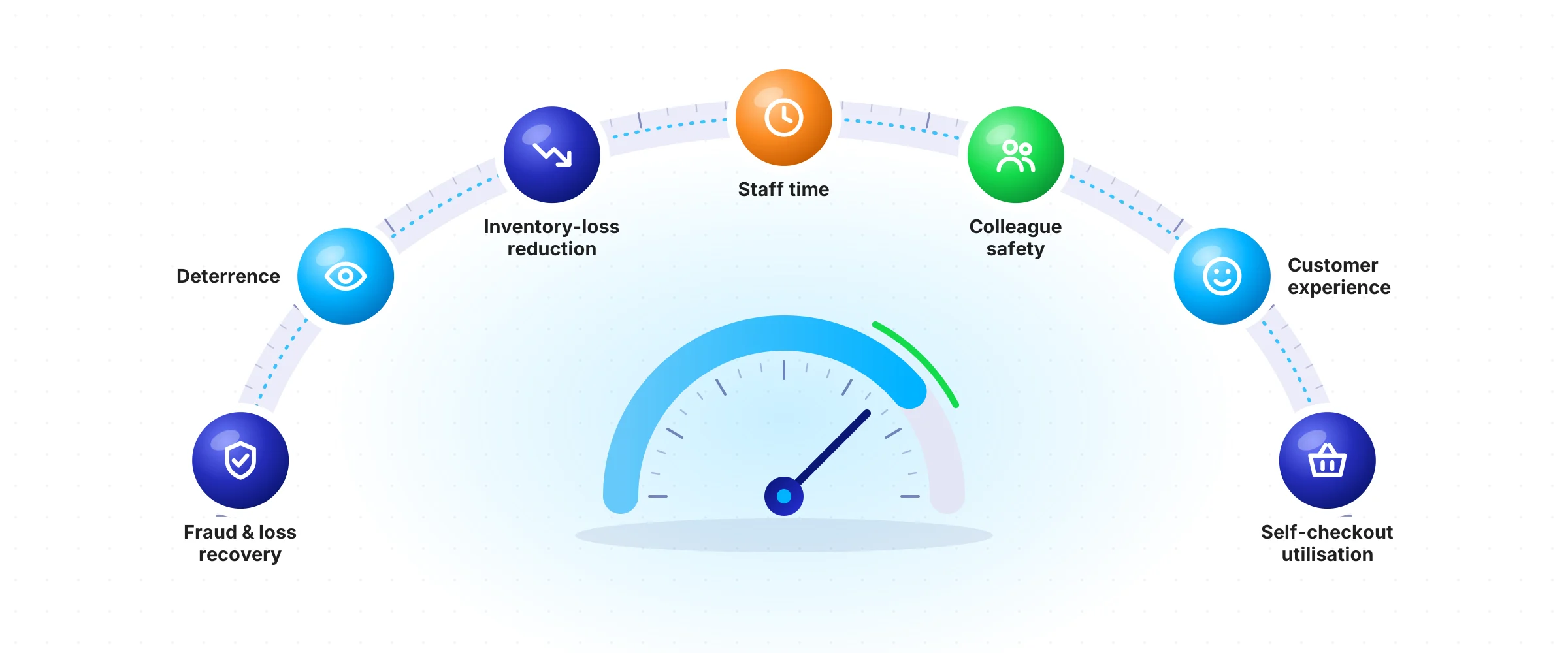
Instead consider a balanced set of business outcomes, including:
- Fraud and loss recovery: Is the technology identifying events that translate into prevented or recovered loss?
- Deterrence: Is visible Vision AI discouraging potential theft before an intervention is needed?
- Inventory-loss reduction: Is shrink actually improving?
- Staff time: How much attendant intervention does the system require?
- Colleague safety: Does the intervention approach minimise unnecessary confrontation and enable colleagues to respond safely?
- Customer experience: Does the technology reduce loss without introducing unnecessary friction?
- Self-checkout utilisation: Are shoppers continuing to choose self-checkout?
These measures offer a more meaningful picture of whether Vision AI is creating value.
The “best” result depends on who you ask
There is another reason a single technical metric is unlikely to provide the answer: Vision AI affects multiple parts of the retail organisation.
Loss prevention may naturally prioritise stopping more loss. Store operations may focus on how much time colleagues spend responding to interventions. Customer experience teams will care about friction. Technical teams will focus on whether the solution integrates with existing systems and fits the retailer’s technical architecture, network requirements and security practices.
Those priorities can pull in different directions.
For example, increasing the number of interventions might appeal from a loss-prevention perspective, but the operational consequence may be more attendant workload and greater shopper friction.
Neither perspective is wrong. The challenge is finding the point at which the technology delivers the best overall outcome.
That means defining success collectively rather than allowing one metric, or one stakeholder, to become the sole measure of performance.
Define success before the pilot starts
Like any technology deployment, a Vision AI pilot should start with a clear definition of success. Before deployment, retailers and technology providers should agree what a successful outcome looks like and how it will be evaluated.
If reducing inventory loss is the primary objective, by how much does it need to improve? What level of attendant effort is acceptable? What happens to self-checkout utilisation? What does an acceptable customer experience look like alongside the loss-prevention objective?
This turns a pilot from a technology test into a business evaluation.
It also creates a much stronger basis for a purchasing decision because the question at the end is no longer simply:
“How accurate was the AI?”
It becomes:
“Did it deliver the outcome we set out to achieve, without creating unacceptable consequences elsewhere?”
From model to operational performance
As Vision AI becomes entrenched in physical retail, how the industry measures it needs to mature too.
Accuracy, false positives and other technical measures still have an important role. They help explain how a system is performing and can help identify where it needs to improve.
But they shouldn’t become proxies for business value.
Retailers don’t ultimately invest in Vision AI to achieve a particular accuracy percentage. They invest because they want to solve real operational problems, whether that means reducing loss, recovering revenue, making better use of staff time or creating a smoother checkout experience.
The measure of successful Vision AI isn’t simply how well the model performs. It’s how well the store performs because of it.
Read more:
Explore more on measuring, tuning and getting real value from self-checkout Vision AI.
- AI checkout loss prevention: 5 frequently asked questions. The questions retailers ask most when evaluating checkout AI, from real-time processing to performance in a live store.
- Self-checkout 2.0: Rethinking retail security and the shopper experience. How Vision AI secures every self-checkout format, and the metrics that show it’s working.
- Defining false positives: Why outcomes matter with Vision AI. A closer look at precision, recall and the hidden value of false positives.
- EDEKA Paschmann combats shrink with AI-powered self-checkout. Reducing inventory discrepancies and fraud by detecting missed scans and prompting customers before payment.
- Explore SeeChange AI Self-Checkout or talk to our team about defining success for your next pilot.