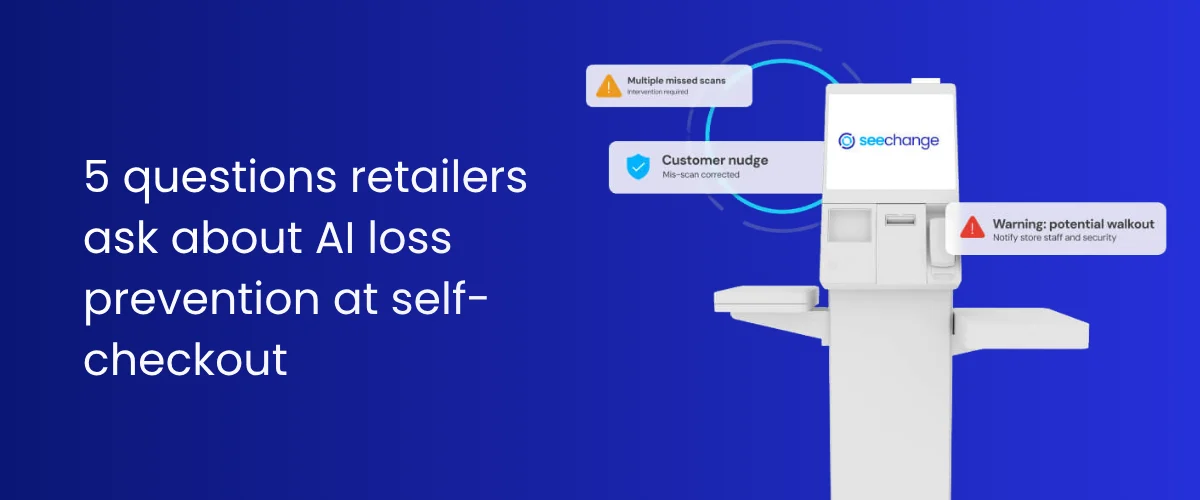
AI checkout loss prevention: 5 frequently asked questions
14th October 2026
What retailers want to know about AI at checkout
For retailers exploring checkout AI, the challenge goes beyond detecting missed scans, barcode switches and other loss events. It’s about delivering measurable results in live stores, integrating with existing infrastructure and fitting naturally into store operations. Drawing on the questions we hear most often from retailers in our lab and live Simu-Lab sessions, we explore what really matters, from deployment and operations to shopper experience and real-world performance.
Read on for answers to the five questions we hear most, or put Vision AI to the test in a live Simu-Lab session.
1. What does a good false positive rate look like?
It’s a common question, but it’s only part of the picture. A false positive rate tells you how often a system raises an alert unnecessarily. On its own, however, it doesn’t tell you how many real incidents the system detects or misses.
At self-checkout, modern systems can achieve very high levels of precision. In wider store environments, such as aisle-based concealment detection, retailers often deliberately tune systems to strike the right balance between identifying risk and avoiding unnecessary colleague interventions. Increasing sensitivity allows more incidents to be detected but may generate more alerts. Reducing sensitivity lowers noise but can also mean missing genuine events.
This is why false positive rates alone can be a misleading measure of performance. Every detection carries a confidence score, and retailers ultimately decide where to set the threshold based on their operational priorities, risk appetite, and customer experience goals.
As computer vision technology matures, baseline detection accuracy becomes less helpful in distinguishing vendors.
The real question is not whether false positives exist, but how effectively a solution is deployed, tuned, and managed in a live retail environment.
2. How can the AI tell when shoppers are together, rather than just standing at neighbouring tills?
Modern Vision AI systems are designed to understand who is interacting with a checkout and which items belong to that transaction. Each shopper is assigned a unique identity, and products are associated with that shopper based on their interactions. As a result, people waiting in a queue or looking for an available checkout lane do not generate alerts because they are not actively engaged in a transaction.
The same intelligence extends to real-world shopping behaviours. Family members shopping together, children accompanying parents, or companions helping with a purchase can be associated with the same transaction.
3. What compute is required in the store? Can AI checkout systems run in the cloud?
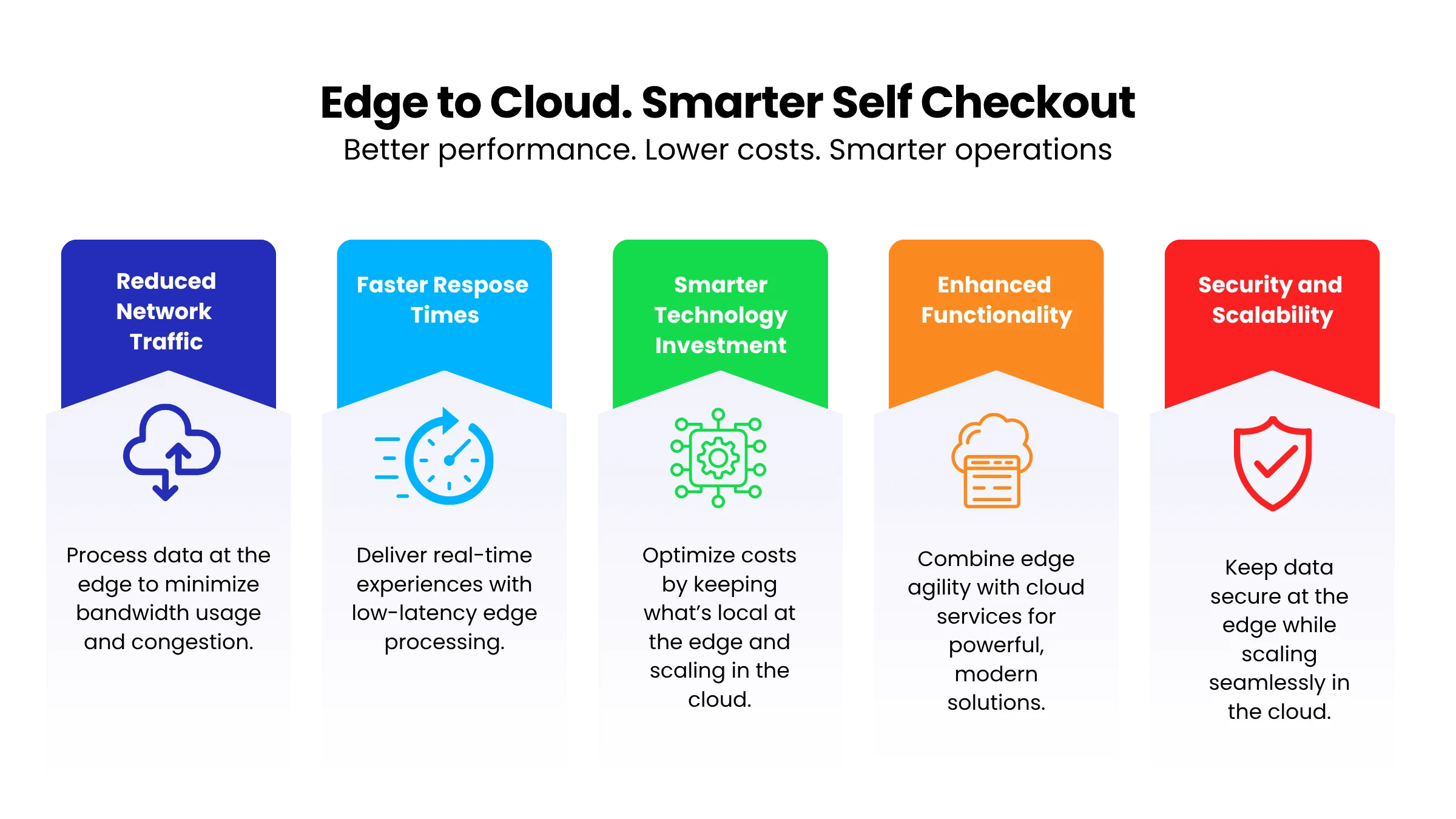
For real-time intervention, inference needs to happen at the edge. Retail environments typically do not have the bandwidth, latency, or resilience required to stream large volumes of video to the cloud and generate responses quickly enough to influence a live transaction without creating shopper frustration.
To prevent loss at self-checkout, you need to intervene while the transaction is still taking place. Recognizing a missed scan, understanding what happened, and notifying the shopper in real time must happen in milliseconds, not seconds.
A useful benchmark is a response time of under 200 milliseconds — faster than the blink of an eye.
In practice, retailers can choose from several deployment models depending on the size of the estate. Larger self-checkout environments often use a shared edge server that processes multiple checkout lanes from a single device, while smaller stores may deploy compact, edge units directly at each checkout.
4. Can the same system work on staffed checkouts and hybrid checkouts?
Yes. The same Vision AI building blocks can be applied across multiple checkout formats, but the way the system responds can be tailored to each environment.
On staffed checkouts, alerts are directed to the colleague rather than the shopper. For example, a retailer may prefer to provide managers with evidence of potential sweethearting or procedural issues instead of interrupting the transaction in real time.
For hybrid and self-checkout environments, interventions can range from shopper prompts and nudges to colleague alerts, depending on the retailer’s operating model and desired balance between loss prevention and customer experience.
The result is a flexible approach that allows retailers to apply the same underlying AI platform across staffed, self-service or hybrid journeys while adapting interventions to suit each format.
5. Do checkouts need security scales for AI to work?
While security scales still play a useful role in scenarios such as weight discrepancies and loose produce, they are no longer the only way to validate a transaction.
Vision AI can often detect behaviours that scales cannot, such as items left in basket. Rather than relying on a single sensor, modern loss prevention systems combine computer vision, transaction data, and business logic to build a more complete picture of what is happening at the checkout.
Where scales exist, they provide another data point. Vision AI can also support the scale by confirming when an item has been seen, helping reduce unnecessary alerts and improve the shopper experience.
This said, retailers are increasingly exploring scale-free approaches that use AI to validate shopper interactions and identify genuine risk without relying on bagging-area weight checks.
The result is a more flexible checkout experience that can reduce friction for shoppers while giving retailers greater visibility into loss events.
The real test of Checkout AI
As retailers evaluate and begin deploying AI for checkout loss prevention at scale, the conversation quickly moves beyond detection accuracy. The real test is a solution’s ability to operate reliably in live stores, integrate with existing infrastructure, adapt to different checkout formats, and deliver measurable outcomes without disrupting the shopper experience.
Today’s Vision AI systems do far more than identify missed scans. They can understand shopper interactions, operate in real time at the edge, support multiple checkout journeys, and work alongside existing technologies such as security scales. Just as importantly, they allow retailers to tailor interventions to their own operating model, balancing loss prevention, colleague workload, and customer experience.
As we’ve seen both in the lab and in live deployments, the discussion quickly shifts from “Can AI detect a loss event?” to “Can it help inform better decisions, reduce unnecessary friction, and deliver sustainable results at scale?” Ultimately, that is where the true value of checkout AI lies.
Read more