How edge-to-cloud computing powers real-time self-checkout
10th July 2026
What is edge-to-cloud computing?
Edge-to-cloud computing is a way to divide the computing tasks between devices located close to where data is created (the edge) and central cloud infrastructure.
For retail and loss prevention at checkout, the “edge” is a local computer, or server, that sits in the store connected to the cameras and checkouts. The “cloud” is a data center somewhere else, reached over the internet.
Timing decides where each task runs. Anything instant runs locally; anything that can wait runs in the cloud. So real-time validation at the checkout runs on a local server, while training the software, reporting across stores, and long-term storage run in the cloud.
Underneath that split sits a three-way balance between latency, bandwidth cost, and privacy. Local processing keeps the checkout responsive, holds bandwidth costs down, and limits privacy risk by sending less imagery to the cloud. The cloud earns its place by sharing heavier workloads across more efficient processors and pulling data together across the estate for analytics. It’s local for speed, cloud for scale.
Why latency decides where self-checkout AI runs
Latency is the delay between an event occurring and the system responding. In self-checkout environments, that delay can determine whether a vision AI solution is accepted by shoppers and store colleagues or quickly becomes a source of frustration.
For real-time interventions, retailers should be thinking in milliseconds.
A useful benchmark is a response with sub-200 milliseconds latency, roughly within the duration of a human blink, which typically lasts between 100 and 400 milliseconds.
The laws of physics are difficult to overcome. When data travels from a store to a cloud data centre and back again before an action can be taken, latency is inevitable.
Retailers could reduce that delay with high-performance network connections, but at a significant initial cost. Running real-time processing on an in-store edge server delivers the speed retailers need at a fraction of the cost, which is why edge computing sits at the heart of most vision AI deployments.
This isn’t a case of edge versus cloud. The real opportunity comes from using both intelligently. Investment in high-performance cloud networks becomes far easier to justify when its value is spread across multiple AI applications, data services and operational workloads across the retail estate.
Many companies who moved everything to the cloud were caught out by rising, unpredictable bills, and are now shifting steady workloads back to local edge devices.
What is an edge device?
Early vision AI deployments for checkout often relied on large servers designed for store formats with dedicated back-office space. They were powerful, but also noisy, generated significant heat and weren’t always practical. As one retailer put it, they “sound like a 747.”
Fortunately, the technology has moved on. Today’s retailers should expect far greater flexibility, with infrastructure tailored to different store formats and operational requirements.
In some cases, a single compact unit can support multiple self-checkouts. In others, for example a store with only three self-checkouts, processing can run on a small edge device housed within the checkout itself.
And thinking beyond checkout, retailers are increasingly planning for how they use shared infrastructure to support multiple AI applications from loss prevention at self-checkout to on-shelf availability, inventory monitoring and operational analytics.
That flexibility is what matters. Retailers shouldn’t be choosing between one-size-fits-all hardware options. The right architecture should adapt to the store format, the number of lanes, the applications being deployed today and those planned for tomorrow.
Ultimately, the question isn’t whether you need a large server or a small device. It’s whether the platform can scale and evolve with your business. As edge processing becomes increasingly embedded into retail technology, infrastructure will become less visible but flexibility will become even more important.
How edge processing protects sensitive data
A hybrid approach allows retailers to use the cloud for tasks that benefit from scale, such as training AI models, deploying updates, and analysing performance across multiple locations, while keeping high-volume, sensitive, or operationally critical processing within the store.
By processing data at the edge, less information needs to travel across networks, reducing bandwidth requirements and limiting exposure of sensitive data. While no architecture removes risk entirely, keeping more processing local can help reduce potential points of vulnerability.
The result is a more balanced infrastructure that combines the scalability and flexibility of the cloud with the speed, resilience, and control of edge computing. For retailers, this means access to real-time intelligence where it matters most, without sacrificing long-term agility or operational efficiency.
How edge-to-cloud keeps self-checkout moving
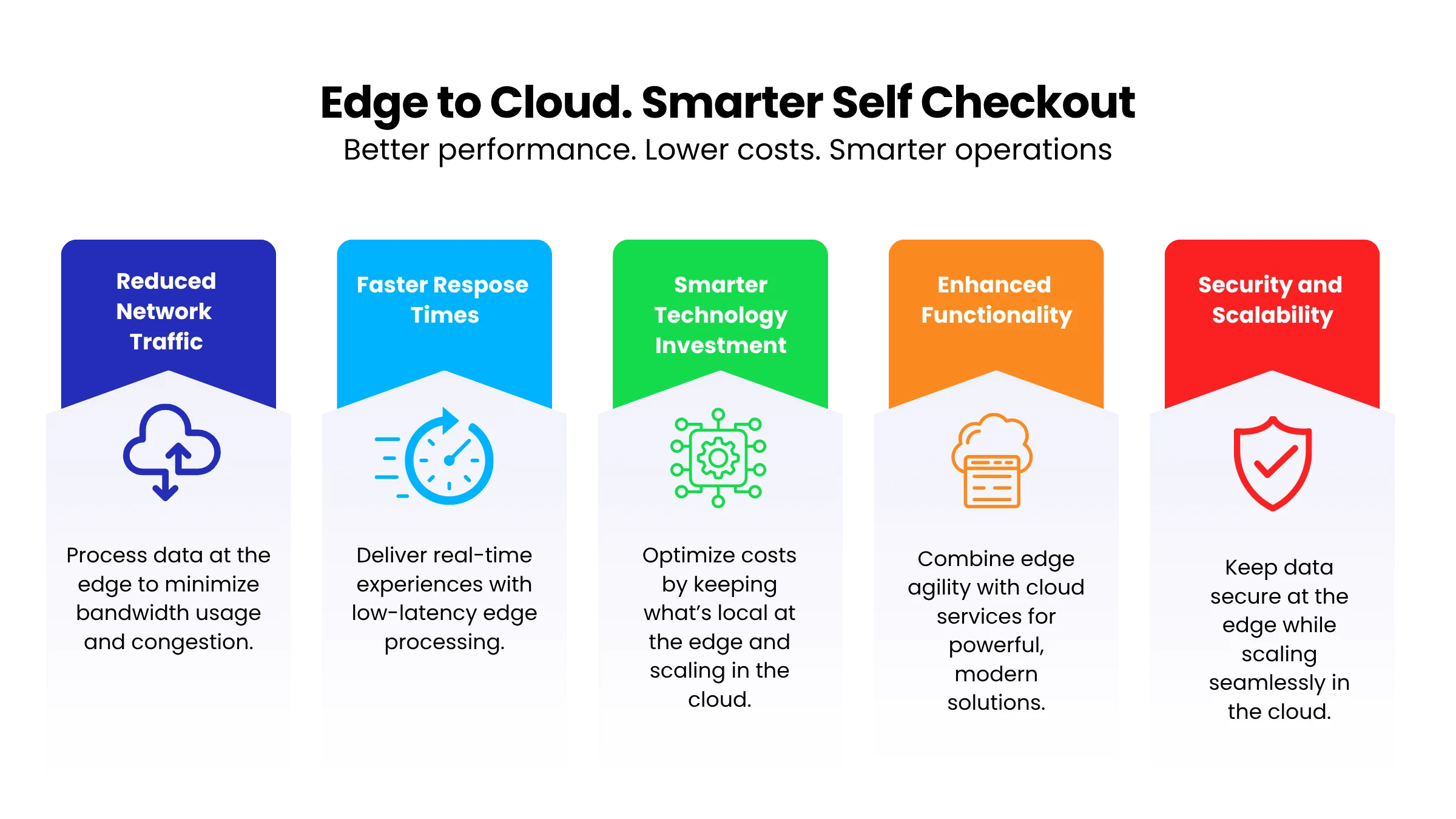
When edge and cloud each handle the tasks they’re best suited for, self-checkout performance improves:
- Reduced network traffic: By only sending data when necessary, the SCO minimizes the amount of data flowing to the cloud, saving bandwidth, reducing costs and safeguarding sensitive data
- Faster response times: Local processing at the self-checkout handles basic tasks instantly, reducing reliance on cloud communication and minimizing delays caused by network latency. The result? Smoother and faster transactions.
- Make technology investments work harder: Edge-to-cloud computing places the right level of compute in the right place. Latency-sensitive tasks run locally, while more CPU- and GPU-intensive workloads are handled in the cloud. This right-sizing approach improves hardware utilisation, reduces infrastructure costs, and maximises the value of both edge and cloud resources.
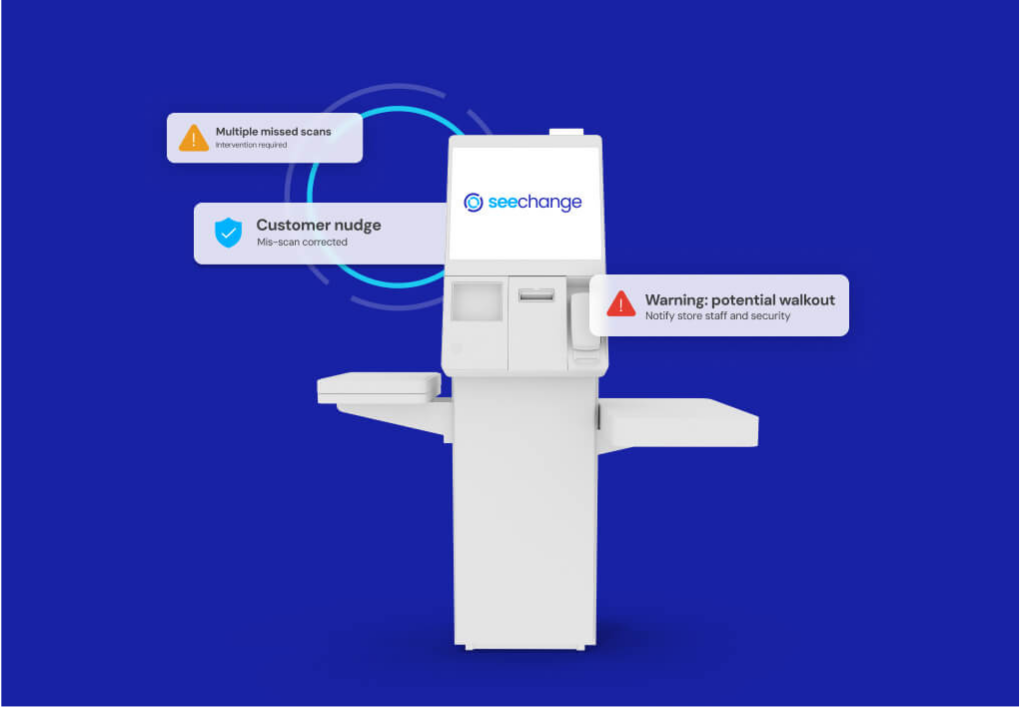
- Enhanced functionality: Real-time validation at the edge helps distinguish genuine loss from honest mistakes, reducing false alerts. Shoppers can correct errors themselves, keeping queues moving and freeing employees to focus on helping customers rather than resolving routine checkout issues.
- Security and scalability: Local processing supports real-time monitoring and anomaly detection, while cloud services provide the scale needed to manage large estates, deploy updates, and continuously improve system performance across stores.
The right infrastructure starts with the right outcome
The debate is often seen as edge device versus cloud, but for retailers, the real question is much simpler: what needs to happen, and how quickly does it need to happen?
At self-checkout, decisions often need to be made in fractions of a second. That is why edge computing plays such an important role in Vision AI deployments. It delivers the speed required to support shoppers in the moment, while the cloud provides the scale, analytics and continuous improvement that make the system smarter over time.
The result is not a choice between edge or cloud, but the right combination of both. Striking the right balance reduces infrastructure costs, improves responsiveness, protects company-sensitive data and create a smoother self-checkout experience for both shoppers and colleagues.
Ultimately, the edge devices aren’t the investment. The outcome is.
-
See how that outcome works in practice: how vision AI secures self-checkout (guide)
-
Talk to our team about edge-to-cloud for your estate
Topics:

Hoomi Chadirchi
Chief Architect