Defining false positives: Why outcomes matter with Vision AI
21st October 2025

Insights from Andrew Smith, Principal AI Solutions Engineer, and Lazar Rankovic, Principal Machine Learning Engineer, SeeChange self-service solutions team.
As developers of computer vision AI solutions, we’re often asked by prospective customers:
“What’s your false positive rate?”
A false positive is synonymous with a false alert. So, asking for a system’s false positive rate provides an alluringly simple metric that should allow a retailer to compare ‘like’ solutions.
Yet a false positive rate only tells part of the story. It certainly helps understand how often a system flags normal activity incorrectly, but it doesn’t consider how often events of interest are identified correctly — or in fact, missed altogether. A system tuned to eliminate false positives may in fact miss many real incidents, defeating the purpose of AI.
When it comes to AI-driven systems, false positives are useful: they provide feedback that helps a system learn and improve over time. They also play a part in two important metrics:
- Precision: Of all flagged incidents, how many were correct?
- Recall: Of all real incidents, how many were detected?
Using precision and recall instead of just the false positive rate provides a more comprehensive evaluation of a system’s performance.
This blog explores the value of false positives, defines precision and recall in AI-driven systems, and highlights how to ensure your chosen solution helps optimize operations, improve shopper and employee experience.
Measuring performance: What triggers ‘false positives’ and how to address them
Consider an AI-powered self-checkout system: at its core lies a Machine Learning engine that predicts outcomes by analyzing patterns from historical data, allowing it to make informed deductions about future or unseen information.
Outcomes will fall into one of four categories:

A false positive rate is often calculated as a percentage of alerts, using the formula: FP / (FP + TP).
However, this method doesn’t allow for fair comparisons between different solution providers as it only reflects results from specific conditions in a particular store. To truly compare systems, they must be tested under the same conditions—identical stores, checkouts, and timeframes. Without this, metrics like the false positive rate can be misleading.
Formally, a false positive rate is calculated using the formula: FP / (FP + TN). While this provides a more universal measure of how often the system flags normal activity incorrectly, it still doesn’t show how well the system detects real incidents (true positives) or how many it misses (false negatives).
This is where precision and recall come in:
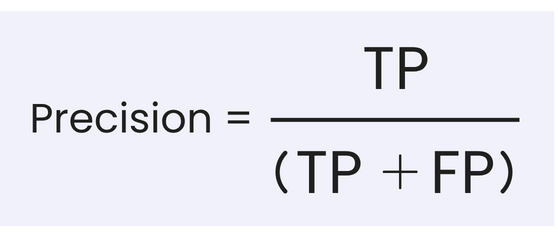 | Precision measures how many of the alerts raised are correct.
|
 | Recall measures how many actual theft or error events the system detects out of all that occur.
|
Takeaway: Precision and recall need to be considered together to understand the overall performance of a system. Only by measuring both can retailers see how well a solution actually protects against loss, supports employees, and maintains a smooth shopper experience.
The role of logic in reducing false positives
When comparing Vision AI systems, one of the most important questions a retailer can ask is when false positives come up frequently, how does the solution provider tune the solution to respond?
In many cases, the difference between a system that performs well and one that doesn’t lies in the logic layer, the rules and reasoning that guide how the AI system interprets what it sees. For example, in tightly spaced stores where self-checkouts sit close together, false positives may occur because nearby shoppers and items enter the field of view or overlap with an area of interest. The fix in this situation is not to ask the retailer to create more space around the self-checkouts. The fix is to refine the system’s logic so it can distinguish between shoppers at adjacent tills.
A solution provider’s ability to deploy and adapt such intelligent logic determines how effectively the solution will maintain accuracy and performance over time.
Systems are structured. Human behavior is unstructured.
While store layouts will be established, planograms will guide displays, checkouts will follow a designated order, and employees will receive training; humans are inherently unstructured. In other words, we naturally introduce unknowns into any environment – the key is being able to embrace this complexity and adapt effectively.
Case study: How deli operations affected false positives
Often what is viewed as ‘false positive’ is in fact a system behaving correctly. They provide insights into store operations, shopper and attendant behavior, helping retailers to understand how processes, environment or behavior can add to the noise of a system.
Real-world example: A retailer deploying an AI-powered self-checkout system offers shoppers an in-store deli experience. Shoppers request items from the deli, the attendant serving them bags the items individually (e.g. cheese in a separate bag to meat) before placing a single barcode onto only one of the bags.
When the shopper uses the self-checkout, they scan the single barcode and place multiple items into the bagging area. This is immediately flagged; one item has been scanned yet four have now appeared in the bagging area.
The shopper would rightly be frustrated if their journey is interrupted, yet as a retailer you want to know when items have passed into the bagging area without scanning and want the system to alert for this.
The answer is an operational change, asking deli staff to place all individually bagged deli items into one overall bag and place the single barcode on this outer bag.

Takeaway: False positive or alerts may require process realignment which, when fixed, can improve both system performance and shopper experience.
Case study: The impact of store cleanliness on false positives
Vision-AI systems in a checkout zone monitor specific areas of interest. These may be the basket area, the trolley, the bagging area, the weigh scale, etc. In every new retail store or environment, there will be a period of ‘calibration’ to ensure areas of interest are mapped accurately, and that anything permanently in those areas (such as a receipt printer) is ‘masked’ or ignored by the system – this prevents, for example, the printing of a receipt being seen as a product. Once this calibration and tuning is complete, anything in the areas of interest can then trigger an event should missed scans occur.
Real-world example: If a shopper decides, mid-transaction, they no longer want to purchase an item, they may leave it somewhere on or around the self-checkout for someone to remove. Should the discarded item then not be cleared away by an attendant in the area, this product can go on to create false positives for every transaction that subsequently takes place at that self-checkout as the item has been deemed to be a ‘miss-scan’.
In this case, the solution isn’t to relax the Vision AI system, but to ensure attendants are aware of the impact of not maintaining clear checkout zones.
Another example is if a sticker is placed in the checkout zone to promote a loyalty card; this could well be identified by the system and trigger alerts. The answer is to fine-tune the system.
Takeaway: False positives aren’t a sign the system is failing — they highlight opportunities for calibration and process improvement. By responding to these alerts, retailers can refine the system, maintain clear checkout areas, and ensure the AI continues to learn and adapt — all while keeping operations smooth and minimizing losses.
Computer vision AI and the role of human-in-the-loop
While Vision AI is powerful, it cannot fully understand context in every scenario. Keeping a human in the loop ensures that true and false positives are managed intelligently to catch the real issues that matter:
- Low-confidence events can be routed to staff for verification rather than being ignored, preventing them from turning into losses.
- Operators or attendants provide contextual judgment, distinguishing between harmless shopper behavior and genuine risk, refining system accuracy over time.
- Human review feeds back into the Vision AI system, training it to recognise new shopper patterns or edge cases and improving overall system performance.
Takeaway: The most effective deployments don’t aim for zero false positives, they aim for intelligent management where humans and Vision AI together filter noise, catch true incidents and continually improve accuracy over time. As seen at leading French retailer Intermarche, such an approach saw frontline employees gain clarity and confidence in their role, reducing stress and becoming active partners in the system’s success.
The risk of over-tuning vision AI systems
False negatives are critical in a machine learning system as they represent missed detections of a positive case. False negatives occur when a system fails to detect an event of interest, such as shop theft.
When systems are overly adjusted to minimize false positives, they may also be tuning out events of interest. Reducing alerts may make the system ‘quieter,’ but it also lowers sensitivity, creating blind spots where real issues go unnoticed, and every missed incident directly contributes to shrink.
Rather than lowering sensitivity the better approach is periodic sampling of transactions to ensure that the system is performing as expected and to ensure that new shopper behaviours are being accounted for.