How to choose an AI retail loss prevention software vendor: Beyond the lab
21st May 2026
Retailers implementing Vision AI for loss prevention, to secure full-store or checkouts, will often start the same way: a lab trial, or a controlled single store pilot, before any wider rollout. This makes sense – try it before you buy it – except, there’s a real risk in confusing accuracy in a structured test environment with performance on a live shop floor and across a full retail estate.
The store environment can be messy. Shoppers behave in ways no test script can predict. Stores are typically less stable, less tidy and less consistent than any lab.
The technology you put in front of customers has to cope with all of this and still reflect the experience you want. This short Q&A will walk you through what to look for in a Vision AI vendor: flexibility, real-world proof, and the ability to keep the shopper experience firmly in the retailer’s hands.
Why a strong lab result isn’t good enough when choosing a Vision AI vendor
Lab environments are tidy. They’re structured, predictable and built to make a system look good. Real stores are not. Shoppers do unexpected things. Promotional stickers appear in camera fields of view. A high accuracy score from a controlled test tells you very little about how a system will hold up against scenarios like this.
It is also why a single headline number – such as a vendor’s quoted false positive rate – can hide as much as it reveals. You need to look at precision and recall together, and at how the vendor responds when store conditions change. A system tuned to look quiet in a demo can be the same system that misses real theft events on a busy shopping day.
What does “flexibility” actually look like in a Vision AI deployment?
Flexibility is one of those words that gets used a lot, but is rarely defined. In practice, it should mean two things. First, the vendor lets you shape how the system behaves – how alerts are generated, what triggers an intervention, where a human sits in the loop and how much friction lands on the shopper. Second, the platform must adapt to your environment without ripping out what you already have.
SeeChange’s work with retailers reveals shows what this looks like in practice when it comes to full-store loss prevention:
- A Security Operations Centre-led model maximises recovery where staffing supports it.
- An aisle-to-checkout model links concealment detection to automated checkout interventions.
- A detection-only model captures the data without interrupting the shopper.
Real flexibility means a vendor can offer all three loss prevention models – and can integrate with existing CCTV, self-checkout hardware and cloud infrastructure so you’re not starting from a blank slate.
How can a retailer balance shrink reduction with customer experience?
Every retailer wants to reduce losses. Every retailer also wants the shopping experience to feel easy and trusted and have minimal disruption on employees. Those goals pull in different directions, and the right balance will be different for every business.
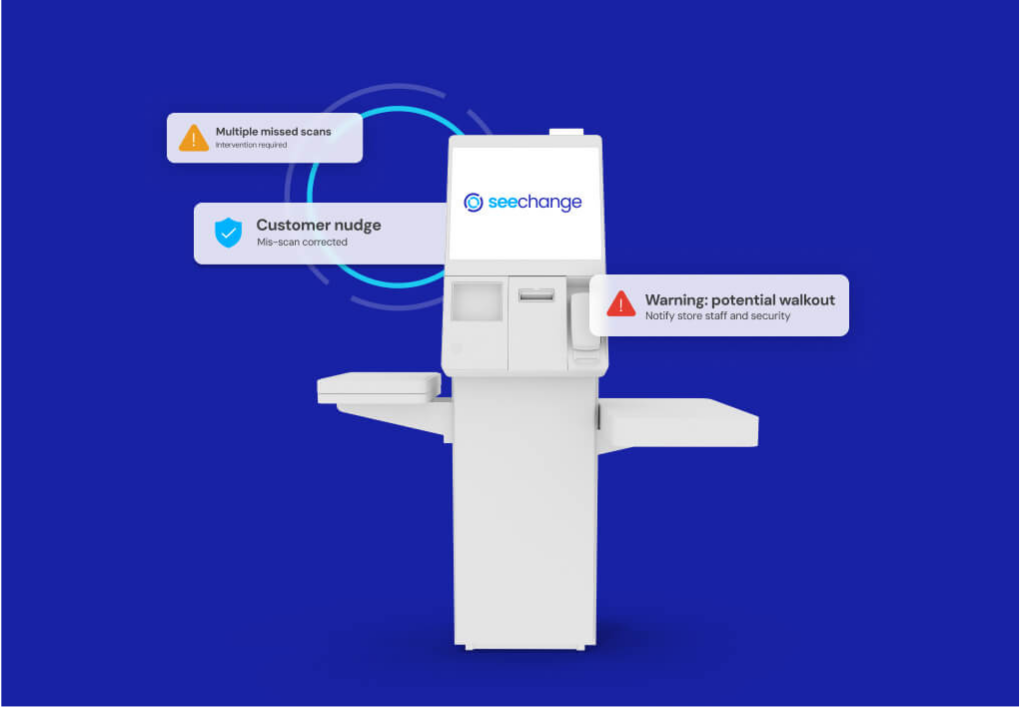
For example, at self-checkout retailers need to be able to choose when to act on events identified by the vision AI system. When it’s a simple nudge to the shopper to self-correct versus a block that requires attendant support. Retailers may also want to give store managers the ability to dial down sensitivity and alert frequency based on time of day or if there’s a local event that is driving unusually high footfall in store and queue busting becomes a priority.
The system you choose should be tuneable to your priorities, and the conversation should start with the outcome you want, not the technology on offer.
Hear from leading French grocery retailer Intermarche Inside self-checkout: Intermarché and AI-powered shrink reduction | SeeChange
What questions should retailers actually ask a Vision AI vendor?
Here’s a short, practical checklist worth taking into vendor conversations:
- Can you come into our stores and prove it works there, not just in a demo environment?
- How do you handle the messy realities – heavy store traffic, layout changes, new promotional material in the camera’s field of view?
- Can we finetune the system when conditions change?
- Can we control the trade-off between loss reduction and staff intervention?
- What’s the role of a human in the loop, and where do they sit in the workflow?
- Can we run different deployment models across different stores in our estate?
These are the questions that separate the vendors selling a number on a slide from the vendors who will actually deliver a strong outcome for the business.
How does SeeChange deliver real flexibility?
SeeChange has built its Vision AI platform around the variability of real retail environments rather than the comfort of a lab. The loss prevention deployment models discussed above are available as a framework, and can be mixed across an estate.
The SeeChange platform also integrates with existing cameras and self-checkout hardware, runs at the edge with metrics passing to the cloud, and is built so the alerting layer can be tuned to local conditions as they shift. Real-world deployments show this flexible approach holds up where it counts: in live stores, with real shoppers, supported by employees, at all times of day.
Choosing a Vision AI partner built for the real world
A good Vision AI vendor for loss prevention isn’t the one with the best number in a lab demo or highly structured pilot. It’s the one that gives you control over the outcome in your stores – the balance of shrink captured, staff effort and customer experience that fits your business. The rest is detail.
To discover more about our approach, contact SeeChange now.